

Hissing or Bubbling From Your AC: The Refrigerant Leak Conversation
A hiss means something is escaping under pressure. In 2026, finding out where matters more than it used to.
By Roman Shatokhin · Airo Service · Updated October 2026
A steady hissing or bubbling sound from your AC usually means refrigerant is leaking, especially if the air is cool but not cold or there is ice on the line. Turn the system off, keep away from the spot the hiss is coming from, and have the leak found and repaired rather than topped up. A short hiss for a minute after the unit shuts off is normal.
What the sounds mean
- A steady hiss — gas escaping under pressure. On the refrigerant side that is a leak; it can also be a duct leak in an attic or a pressure-relief event, but a hiss near the indoor coil or along the line set is a leak until proven otherwise.
- Bubbling or gurgling — often refrigerant flashing as it moves through the metering device with too little charge in the system. It can also be perfectly ordinary condensate moving through a trap, which is why the rest of the symptoms matter.
- A loud hiss on shut-down that fades over a minute — usually just pressures equalising, and normal.
The sound alone rarely settles it. The pattern of symptoms does.
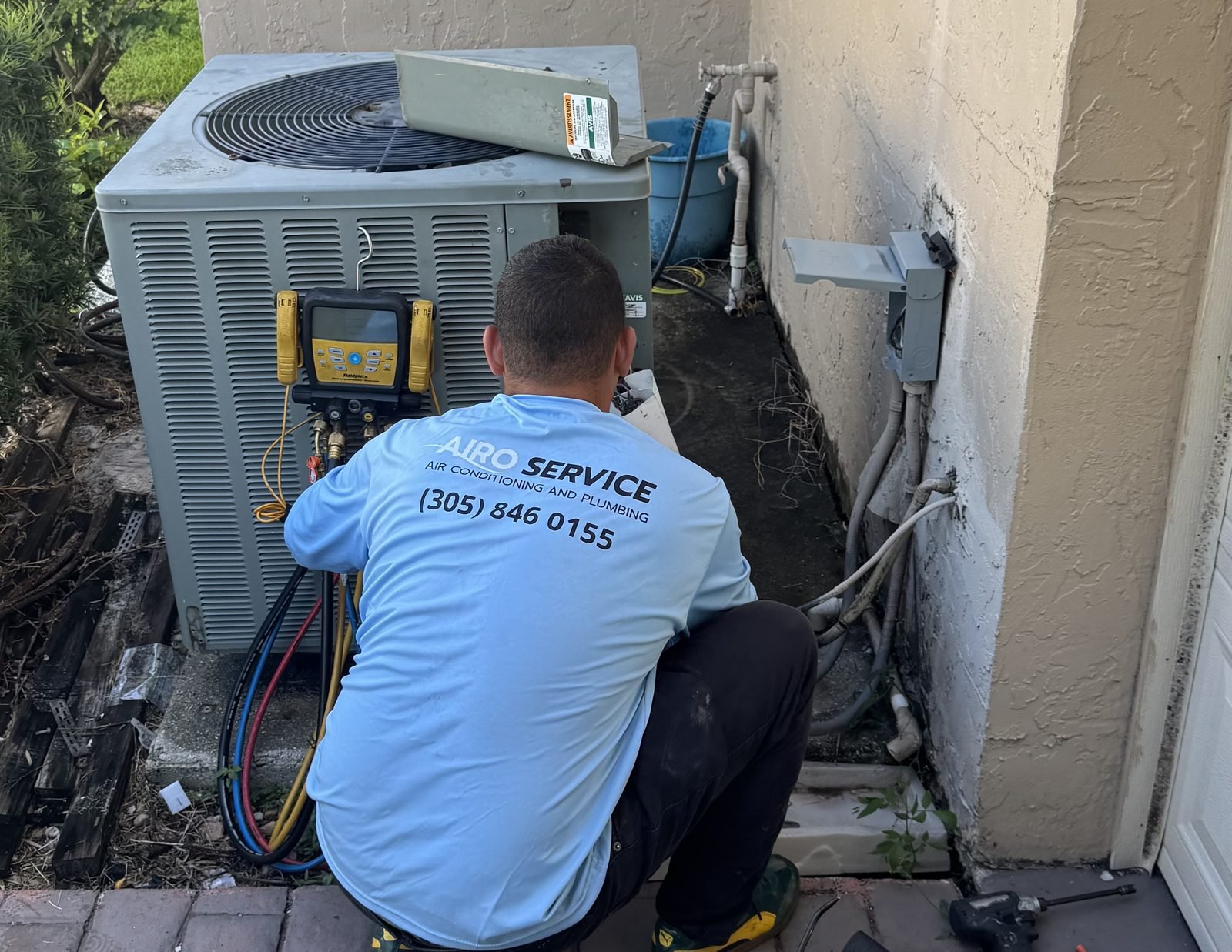
The signs that confirm it
A system genuinely low on refrigerant tends to show several of these at once:
- Air from the vents that is cool but not cold — the system runs and runs without reaching setpoint (AC blowing warm air covers the other causes).
- Ice on the refrigerant line at the air handler, or on the indoor coil itself. This is the classic one, and it is counter-intuitive: low refrigerant makes things freeze, not overheat.
- The house holding humidity even when the temperature is acceptable.
- Longer run times and a higher bill for the same comfort.
- An outdoor unit that runs constantly on a mild day.
If your system is icing up, stop it and let it thaw before anyone tries to diagnose it — the fuller picture is in why your AC freezes up.
Where leaks actually happen in Florida homes
- Evaporator coil. The most common and the most expensive. Formicary corrosion — tiny pinholes caused by household chemicals reacting with copper in a permanently damp environment — is well suited to this climate.
- Schrader valve cores and service caps. Cheap, common, and frequently the entire answer. A missing service cap is not cosmetic.
- Line set rub-throughs. Where the copper passes through a wall or rests against a joist and has been vibrating for a decade.
- Brazed joints. Particularly on installations where the joints were not purged with nitrogen while brazing.
- Condenser coil. Coastal homes especially — salt air is hard on aluminium and copper. See coastal salt-air maintenance.
Is a refrigerant leak dangerous?
In a residential context, a leak is primarily an equipment and cost problem rather than a health emergency. R-410A is non-toxic and non-flammable. It can displace air in a very confined, unventilated space, which is a real consideration in a small mechanical closet, and the sweet chemical smell some people notice is worth acting on — but a slow leak in a normal house is not a reason to evacuate.
Many newer systems use R-454B, which is classed A2L — “lower flammability.” It is hard to ignite, needing a high concentration and a strong ignition source, and most new R-454B air handlers include a leak sensor that runs the blower to disperse refrigerant. Near any hissing line the same common sense applies: do not touch it, because escaping refrigerant is cold enough to cause frostbite; keep flames and sparks away; open a window or door if the hiss is indoors; and switch the system off.
The genuine danger is to the compressor. A system running low is running hot and poorly lubricated, and that is how a leak repair turns into a compressor replacement.
Why “just add a little” stopped being reasonable
Refrigerant is not consumed. A system that is low has a hole. That was always true, but at $8 a pound the industry tolerated topping systems up every spring. At today’s $25–45 per pound, the annual top-up now costs more than finding the leak.
Adding refrigerant without a leak search is also how a small repairable pinhole becomes a coil replacement two seasons later.
What a proper leak repair looks like
- Verify it is actually a charge problem — superheat and subcooling measured, airflow and filter checked first. Restricted airflow imitates low charge convincingly.
- Locate the leak — electronic detector, bubble solution, and where necessary nitrogen pressure testing with the system isolated.
- Repair or replace the component — a valve core is minutes; a line-set section is a braze; a leaking evaporator coil is a decision, not a repair.
- Evacuate properly — deep vacuum to remove moisture and non-condensables, verified with a micron gauge rather than by clock.
- Weigh in the charge — to the manufacturer specification, by weight, not estimated off gauge pressures in the afternoon sun.
Repair or replace?
Roughly: an accessible leak on a system under about ten years old is a repair. A leaking evaporator coil on a system over ten is usually a replacement conversation, especially with R-410A pricing on top. The full arithmetic is in repair or replace an R-410A system in 2026, and the calculator will run your numbers.
| Repair | Typical range |
|---|---|
| Diagnostic, with repair | $0 |
| Refrigerant recharge (R-410A) | $250–$650 |
| Evaporator coil replacement | $900–$2,500 |
| Compressor replacement | $1,800–$3,500 |
The leak repair itself is priced in writing once the leak is located — more by part in AC repair cost in South Florida.
What we will not do is sell you the same three pounds every May.
Frequently Asked Questions
Does hissing always mean a refrigerant leak?
Not always, but it is the most likely explanation when the sound comes from near the indoor coil or along the line set and the system is also cooling weakly. A brief hiss for a minute after shut-down is just pressures equalising and is normal.
Why does my AC freeze up if it is low on refrigerant?
Because lower pressure means a colder coil. With too little refrigerant the evaporator drops below freezing, moisture in the air condenses and freezes on the fins, and the ice then blocks airflow and makes it worse. Ice on the line is one of the clearest signs of a charge problem.
Is a refrigerant leak in my house dangerous?
In a normal home it is an equipment and cost problem rather than a health emergency — R-410A is non-toxic and non-flammable. It can displace air in a very confined unventilated space, so a strong chemical smell in a small closet is worth acting on promptly.
How much does it cost to fix a refrigerant leak?
It depends entirely on where the leak is. A leaking valve core is a minor repair, a line-set section is moderate, and a leaking evaporator coil is a major part plus labour plus a full charge. Any honest quote separates the leak repair from the cost of the refrigerant itself. For reference, a refrigerant recharge (R-410A) runs $250–$650 and an evaporator coil replacement $900–$2,500.
Can I just add refrigerant every year instead?
You can, but it is now the more expensive choice as well as the wrong one. Refrigerant is not consumed, so a system needing an annual top-up has a leak that is getting larger, and running low on charge shortens compressor life.
Is AC refrigerant flammable?
R-410A, used in most existing Florida systems, is non-flammable. R-454B, used in many newer systems, is classed A2L — lower flammability — and is hard to ignite; most new R-454B air handlers include a leak sensor that runs the blower to disperse it. Either way, keep flames and sparks away from a leaking line.
Is it unsafe to be near a refrigerant line that is hissing loudly?
Keep your distance and do not touch it: refrigerant escaping from a line is cold enough to cause frostbite. Switch the system off, ventilate the room if the hiss is indoors, and call for service. A slow leak in a normal house is not a reason to evacuate.
Suspect a Leak? Get It Found, Not Topped Up
Electronic leak detection, nitrogen pressure testing, and a written price before we add a pound of anything.
- ✔ Free, No-Obligation Estimate
- ✔ Upfront Written Pricing — No Surprises
- ✔ 10-Yr Parts / 1-Yr Labor Warranty
- ✔ Serving Miami-Dade, Broward & Palm Beach
Prefer to talk? Call (305) 846-0155.