

The R-410A Phase-Out: What It Actually Means If You Own One in South Florida
Your system is not illegal and nobody is coming to take it away. But three things did change in 2025, and two of them show up on your invoice.
By Roman Shatokhin · Airo Service · August 2026
What actually changed on 1 January 2025
One thing changed, and it is narrower than most of the headlines suggested: manufacturers stopped building new residential air conditioning equipment charged with R-410A. Systems built from that date forward ship with a lower-global-warming refrigerant instead — for most brands sold here, that is R-454B.
That is a manufacturing rule. It applies to factories, not to houses. Nothing about it makes the system in your side yard illegal, unsafe, or ineligible for service.
Three things that did not change
- You can keep running it. There is no requirement to replace a working R-410A system, no deadline, and no inspection that will flag it.
- It can still be repaired. Capacitors, contactors, blower motors, boards, fan motors, drain work — none of that is refrigerant-specific.
- R-410A can still be bought and put into your system. Servicing existing equipment is explicitly allowed. Supply now leans increasingly on reclaimed refrigerant, but it is legal and it is available.
Where it does bite: the price of a pound
The part homeowners actually feel is the refrigerant itself. Wholesale R-410A moved from roughly $8–12 per pound to about $25–45 per pound. It is the same chemical doing the same job, but the production phase-down squeezed supply while a large installed base still needs it.
A typical South Florida three-ton system holds somewhere around eight to twelve pounds. That is the difference between a top-up that used to be an annoyance and one that now reads like a real repair. We wrote the full breakdown in why an R-410A recharge got so expensive.
The second bite: parts, quietly
Refrigerant-side parts for the R-410A generation — condenser coils, evaporator coils, matched compressors — are still being made, but the queue is no longer first in line at the factory. Over the next few years the pattern will be familiar to anyone who has kept an older car: the common parts stay easy, the specific ones start taking days instead of hours.
That matters most in July, when nobody wants to hear that the coil is on back order.
How to find out what you actually have
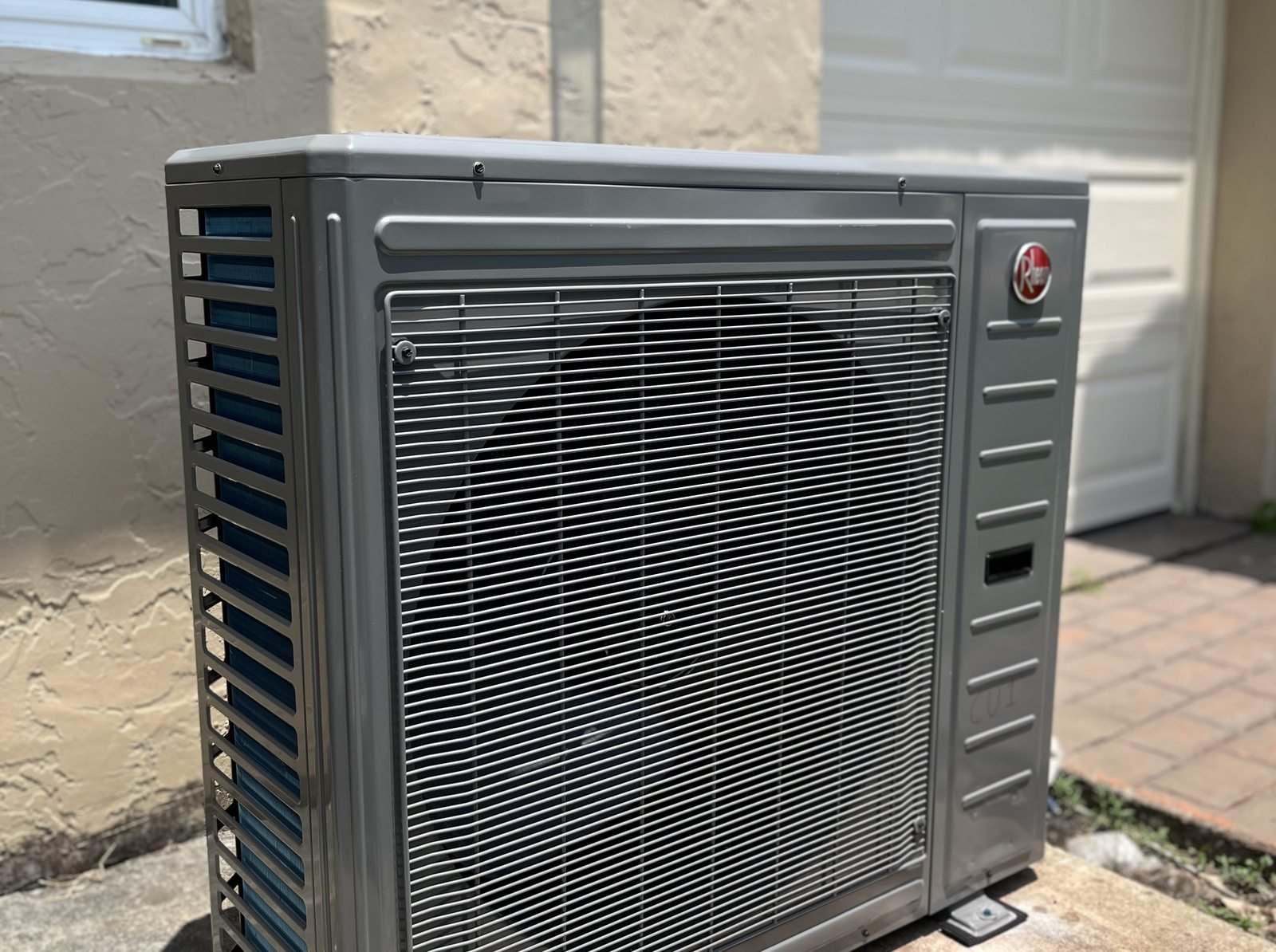
Walk out to the outdoor unit and read the data plate — the metal or sticker panel on the side of the cabinet. There is a line that says Refrigerant or Factory Charge, and it will read R-410A, R-22, or R-454B.
- R-454B — the system was built in 2025 or later. Nothing here applies to you.
- R-410A — most South Florida homes with equipment installed between roughly 2004 and 2024.
- R-22 — that generation went out of production in 2020 and the refrigerant is genuinely scarce and expensive. If you are still on R-22, replacement is usually the only sensible answer.
The decision you will actually face
Almost nobody replaces a working system because of a refrigerant rule. What happens instead is that the rule changes the maths on a repair you were going to face anyway. So the real question is not “should I replace because of R-410A” — it is “what do I do when this system next needs something significant?”
- Non-refrigerant repair on a system under about 10 years old — fix it. A $350 capacitor-and-contactor visit on a 2019 unit is not a replacement conversation.
- Refrigerant leak on a system 8–12 years old — this is the genuine grey zone, and the higher refrigerant price now pushes more of these toward replacement. We laid out the numbers in repair or replace an R-410A system in 2026.
- Leaking coil or failed compressor on a system over 12 years old — in this climate that is almost always the end of the road, and it was before 2025 too.
What we would tell you to do this year
Nothing dramatic. Three practical things:
- Find out what refrigerant you have and write down the model, serial and install year somewhere you will find them at 4pm on a Saturday.
- Take a leak seriously the first time. The old habit of topping up every spring and moving on is now an expensive habit. Refrigerant does not get consumed — if it is low, it went somewhere. Finding a leak while it is small is the cheapest version of this entire article.
- Keep the coils clean and the drain clear. A maintenance visit does not make an old system new, but a clean condenser coil is the single easiest way to keep head pressure — and stress on the compressor — where it belongs.
The honest timeline
If your R-410A system is healthy, you will most likely get its normal remaining life out of it. In South Florida, where equipment runs close to year-round, that is typically 10 to 15 years, and the coastal salt-air homes sit at the lower end of that range.
The change is not that your system stopped being viable in 2025. It is that the cheap escape hatch — dump in more refrigerant and think about it next year — got noticeably more expensive. Plan around that, and there is no emergency here.
Frequently Asked Questions
Do I have to replace my R-410A air conditioner?
No. There is no rule requiring homeowners to replace working R-410A equipment, no deadline, and no penalty for keeping it. The 2025 change applied to what manufacturers may build, not to what you may own or run.
Can my R-410A system still be recharged?
Yes. Servicing existing systems with R-410A remains legal and the refrigerant is still available, increasingly from reclaimed stock. The catch is price — wholesale moved from about $8–12 per pound to roughly $25–45 per pound, so a recharge that used to be minor is now a real line item.
How do I know which refrigerant my system uses?
Read the data plate on the outdoor unit. Look for a line marked Refrigerant or Factory Charge. R-410A covers most systems installed from roughly 2004 to 2024, R-22 is the older generation that went out of production in 2020, and R-454B is what new equipment ships with.
Will R-410A parts become hard to get?
Not suddenly, but gradually. Common electrical parts are unaffected. Refrigerant-side components such as matched coils and compressors are still produced but no longer prioritised, so expect longer waits over the next several years — which is worth thinking about before peak season, not during it.
Is it worth replacing early to get ahead of this?
Only if you were already close to replacing. Scrapping a healthy eight-year-old system to avoid a future refrigerant cost rarely pays back. If the system is over twelve years old, leaks, or has already needed refrigerant twice, then the timing argument becomes real.
Not Sure What You Have? We Will Tell You Straight
A technician identifies your refrigerant, checks the charge, and gives you the honest repair-or-replace maths. Same-day appointments available.
- ✔ Free, No-Obligation Estimate
- ✔ Upfront Written Pricing — No Surprises
- ✔ 10-Yr Parts / 1-Yr Labor Warranty
- ✔ Serving Miami-Dade, Broward & Palm Beach
Prefer to talk? Call (305) 846-0155.