

Clogged AC Drain Line: Why It Happens Every Summer in Florida
Water stains on the ceiling, a shutdown float switch, or a puddle by the air handler — the condensate line is the single most common summer callout in South Florida.
By Roman Shatokhin, Owner & HVAC Specialist · Florida HVAC license #CAC1824778 · Updated August 2026
Your AC makes gallons of water a day
People are surprised by this number. In a humid South Florida summer, a typical home system pulls somewhere in the range of five to twenty gallons of water out of the air on a hot day. All of it lands in the drain pan and leaves through a length of PVC roughly three quarters of an inch across.
That pipe is dark, permanently damp and full of nutrients from dust and pollen. Algae and biological sludge grow in it the way they grow in a neglected fish tank. Then one afternoon the flow slows enough that the pan backs up, and you find out about it through your ceiling.
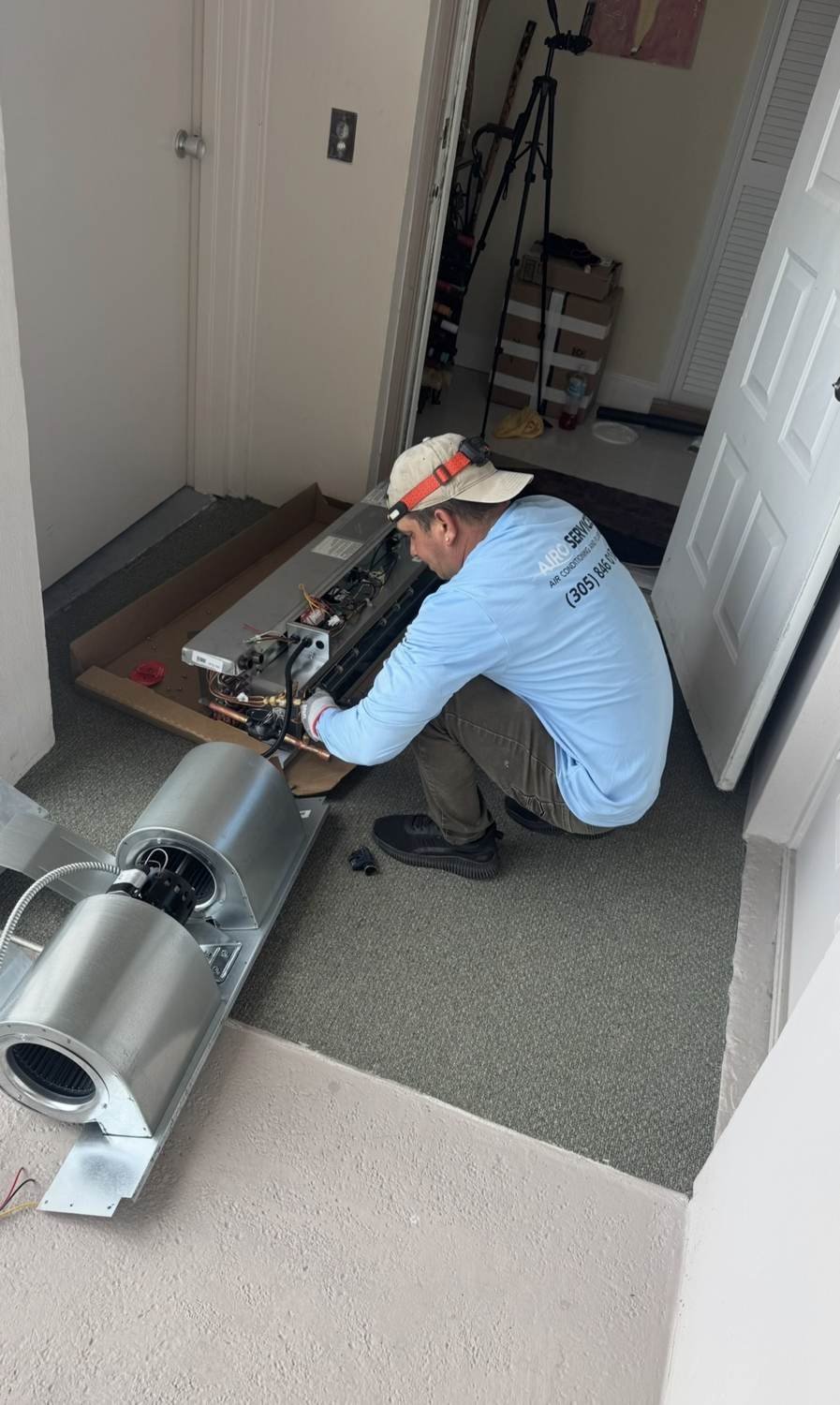
What the float switch is actually doing
If your AC has simply stopped and there is no obvious fault, look at the drain before you assume the worst. Most modern installations have a float switch that cuts the system off when water rises in the pan. It is not a malfunction — it is the safety doing its job and preventing thousands of dollars of water damage.
An AC that shuts down on a hot afternoon, restarts after a while, then shuts down again is describing a partially blocked drain almost word for word.
Signs to catch it before the ceiling does
- Water stains or a soft patch on the ceiling below an attic air handler
- A musty smell that appeared recently — standing water in the pan
- The system cutting out and restarting on hot days
- A puddle or damp carpet near an indoor unit or closet
- No drip at all from the outdoor drain stub on a humid day, when there should be steady water
That last one is the best early warning nobody uses. On a humid day a healthy system drips outside. If yours has gone dry, something upstream is blocked.
What you can safely do yourself
Two things, and only two:
- Turn the system off first — at the thermostat and, if you can do it safely, at the breaker.
- Clear the visible pan water with a wet vac, and apply a wet vac to the outdoor drain stub for a minute or two to pull the blockage from the far end.
What to avoid: bleach poured into the line. It is a popular tip and it corrodes the metal drain pan and any aluminium it contacts over time. If you want to treat the line, use a product intended for condensate systems, or ask us to do it at a service visit. Also avoid pushing wire or a coat hanger down the line — it is easy to puncture the pipe or the pan, and then you have a leak that does not stop when the AC does.
Stopping it coming back
A clog is rarely bad luck. It is usually one of these:
- No maintenance. The line and pan want flushing and treating on a schedule. Once a year is a minimum here; before and during cooling season is better.
- A drain with no fall. A line that runs flat or sags holds water permanently, which is exactly where sludge forms. This is an installation defect and it will keep causing problems until it is corrected.
- A missing or dry trap. The trap is what keeps air from being pulled through the drain and stopping flow. Get it wrong and the line gurgles and drains badly even when clean.
- No secondary protection. On attic air handlers a secondary pan with its own float switch is cheap insurance against a ceiling repair.
When to stop and call
Call if the ceiling is already stained, if the unit keeps shutting down after you have cleared what you can reach, if there is standing water you cannot trace, or if the drain line has been a repeat problem. Repeat clogs almost always mean the pipe itself is pitched wrong or trapped wrong, and no amount of flushing fixes geometry.
Frequently Asked Questions
Why does my AC drain line keep clogging?
Because it is dark, wet and full of dust and pollen, which is ideal for algae and sludge. Repeat clogs usually point to something structural though — a line with no downward fall, a sagging run that holds water, or a missing or badly made trap. Flushing helps, but if the pipe is pitched wrong it will keep happening until that is corrected.
Can I pour bleach down my AC drain line?
We advise against it. Bleach corrodes metal drain pans and aluminium components over time. Use a product made for condensate lines, or have the line flushed and treated during a maintenance visit.
Why did my AC shut off by itself?
If there is no other obvious fault, suspect the float switch. It cuts power when water backs up in the drain pan, which is a safety feature preventing water damage. An AC that stops on hot afternoons and restarts later is a classic partial-clog pattern.
How much water should my AC drain in a day?
In a humid South Florida summer, roughly five to twenty gallons a day for a typical home system, depending on size, humidity and run hours. On a humid day you should see steady dripping from the outdoor drain stub. No drip at all is a warning sign.
How often should the condensate line be cleaned?
At least once a year in South Florida, and ideally checked again mid-season. Because equipment here runs close to year-round, drains accumulate growth faster than in drier climates.
Water Where It Should Not Be?
Drain line clogs are our most common summer call. Tell us what you are seeing.
- ✔ Free, No-Obligation Estimate
- ✔ Upfront Written Pricing — No Surprises
- ✔ 10-Yr Parts / 1-Yr Labor Warranty
- ✔ Serving Miami-Dade, Broward & Palm Beach
Prefer to talk? Call (305) 846-0155.