

Water-Source Heat Pumps in Miami High-Rises: What Owners Should Know
If your condo has no outdoor unit, your AC may be a water-source heat pump tied to the building's water loop. Here is how it works, what fails, and what to check before you replace it.
By Roman Shatokhin · Airo Service · November 2026
What a water-source heat pump is
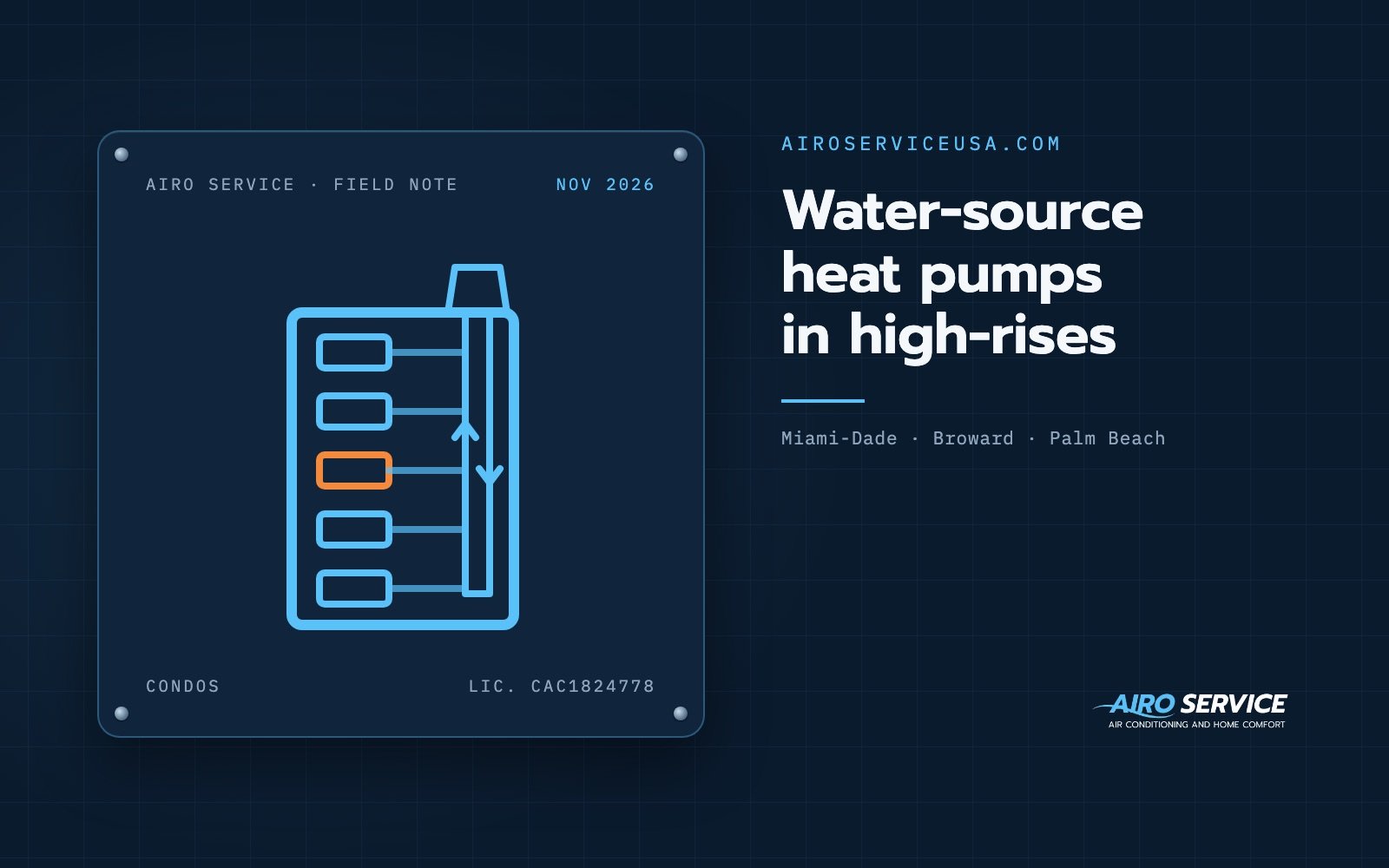
A water-source heat pump is a self-contained heating and cooling unit, usually in a closet or above a ceiling, that dumps your apartment’s heat into a water loop shared by the whole building instead of into an outdoor condenser. A cooling tower on the roof then rejects that heat outside. The unit serves your apartment; the loop serves everyone.
You find them in many Miami high-rises, including towers in Brickell and downtown, because they avoid hanging dozens of condensers on balconies. They work well when the building and the owners each maintain their part. Most of the friction comes from owners not knowing where “their part” ends.
First, confirm what you actually have
High-rises use three common setups, and they get confused all the time:
- Water-source heat pump. The cabinet contains its own compressor — you hear it start with a distinct hum or thump. Two water pipes, usually with shut-off valves and flexible hoses, connect to it. The nameplate typically says “water-source” or lists a water flow rate.
- Chilled-water fan coil. Also connected to water pipes, but there is no compressor inside. The building’s central plant makes the cold water; your unit is essentially a fan, a coil and a valve.
- Conventional split system. Copper refrigerant lines run from the indoor unit to a condenser on a balcony, roof or mechanical floor.
This matters because the troubleshooting, the parts and the replacement rules are completely different for each. If you are not sure, the nameplate model number settles it.
How the building loop affects your comfort
In cooling mode, your unit’s refrigerant circuit moves heat from your apartment into the loop water through a water-to-refrigerant heat exchanger. Pumps carry that water to the cooling tower, which sheds the heat and sends the water back down the risers. In heating mode the unit reverses and draws heat from the loop instead.
The consequence: your unit can only perform as well as the loop water it receives. If the tower is struggling, a pump is down or the water is too warm, every unit on that loop works harder. You do not control any of that — the building does.
A quick way to tell whose problem it is:
- Several neighbors complain the same week → suspect the loop, the tower or the pumps. Report it to management or the building engineer.
- Only your apartment is warm → suspect your unit, its valves, its strainer or its airflow.
What usually fails in the closet
A water-source unit has most of the same parts as any heat pump, plus a water side. The common trouble spots:
- Clogged strainer or partly closed valves. Low water flow through the unit makes it run hot, trip on high pressure and shut down. Valves that have not been turned in years can also seize.
- Fouled water coil. Scale and debris inside the heat exchanger reduce heat transfer. Loop water treatment is normally a building responsibility, but your unit pays the price when it slips.
- Condensate problems. A clogged drain or rusted pan in a closet or ceiling unit leaks into your floor — or your downstairs neighbor’s ceiling. See our guide to AC water leaks inside the house.
- Electrical parts and motors. Capacitors, contactors and blower motors fail here just as they do in any system.
- Worn hoses. The flexible water hoses age. A failed hose on a pressurized loop is a serious leak, fast.
- Compressor and reversing valve. The expensive failures, often after years of running against poor water flow or a dirty filter.
Many of these are fixable. Our heat pump repair technicians diagnose the refrigerant side and the water side together, because treating one without checking the other is how repeat failures happen.
Maintenance that actually matters
Water-source units are often forgotten because nothing sits outside to remind you. At minimum:
- Change the filter on schedule — closet units often have small, awkwardly placed filters that get skipped.
- Keep the condensate drain clear and the pan dry.
- Have the strainer cleaned and the valves exercised, coordinated with the building if the loop needs isolating.
- Inspect the hoses and fittings for corrosion or weeping.
- Check refrigerant pressures, water temperature difference and electrical readings to catch a weak part early.
Our heat pump maintenance visit covers these items. Ask your building whether it requires a specific procedure or notice before anyone touches the loop valves.
Who pays for what: read your documents
Whether the unit, the valves, the riser connections and any water damage are your responsibility or the association’s depends on your declaration of condominium and bylaws — check yours. Buildings differ, and assumptions here lead to arguments after a leak.
Questions worth answering from your documents before anything breaks: who maintains the shut-off valves, who replaces the unit, who must approve a replacement, and what insurance the building requires from contractors. Our article on what your HOA will ask for when you replace a condo AC walks through the typical paperwork.
Before you replace a water-source unit
Replacement is a different project from a house AC. Things that drive the scope and the price:
- Fit. The new unit must fit the existing closet or ceiling space and line up with the existing water, drain and electrical connections. Vertical stack units in particular are often sized to a specific building.
- Building specifications. Loop water temperatures, required flow rate, valve type and voltage all have to match what the building provides.
- Valves and hoses. If the existing valves are seized, they may need replacing, which can require isolating or draining a riser through building staff.
- Logistics. Elevator booking, permitted work hours, certificates of insurance and association approval all take time.
- Refrigerant. Current-production units are built for newer, lower-GWP refrigerants. An existing R-410A unit cannot simply be converted — here is why R-410A systems cannot be converted to R-454B.
- Permit. Replacement is permitted work and has to be done by a licensed contractor.
Because every building is different, we do not publish a standard price for water-source units. The exact price is given in writing after a free assessment of your unit, your closet and your building’s requirements.
Replacing a water-source unit with a conventional split system is rarely practical in a tower: there is usually no approved place for an outdoor condenser, and exterior changes need association approval anyway. In most cases, the right answer is a correctly matched water-source unit, installed and documented properly.
Airo Service repairs, maintains and replaces water-source heat pumps — Trane (authorized Trane dealer), Bosch, ClimateMaster and Comfort-Aire GeoLogix — in condos and high-rises across Miami-Dade, Broward and Palm Beach, including recent projects at Latitude on the River in Brickell, in Coconut Grove and at Grove Isle. See water-source heat pump repair, maintenance and replacement.
Frequently Asked Questions
How do I know if my condo has a water-source heat pump?
Look at the indoor unit. A water-source heat pump has its own compressor inside the cabinet and is connected to two water pipes, usually with shut-off valves and flexible hoses. A chilled-water fan coil also has water pipes but no compressor. A split system has copper refrigerant lines going to an outdoor unit. The nameplate model number confirms it.
Who pays to repair or replace a water-source heat pump in a condo?
It depends on your declaration of condominium and bylaws, so check yours. Buildings differ on who is responsible for the unit, the shut-off valves, the riser connections and water damage. Find those answers in your documents before something fails, and ask management which approvals and contractor insurance the association requires.
Why is my unit not cooling when the building says the loop is fine?
If only your apartment is affected, look at your own unit: a clogged strainer, partly closed or seized valves, a dirty filter, a fouled water coil, a failed motor or capacitor, or a refrigerant problem. A technician can measure the water temperature difference and refrigerant pressures to separate a flow problem from a unit problem.
Can I replace a water-source heat pump with a regular split AC?
Rarely in a high-rise. A split system needs an outdoor condenser, and most towers have no approved location for one. Any exterior change also needs association approval. In most cases the practical choice is a new water-source unit matched to the building's loop specifications and your existing closet or ceiling space.
How much does it cost to replace a water-source heat pump?
It varies with unit size and configuration, how well it fits the existing space, the condition of the valves and hoses, building requirements such as riser shutdowns and work hours, permit costs and equipment availability. Because of that, the exact price is given in writing after a free assessment of your unit and building.
Condo Unit Acting Up?
Tell us what is in your closet and we will explain your options in writing. Same-day service across Miami-Dade, Broward and Palm Beach.
- ✔ Free, No-Obligation Estimate
- ✔ Upfront Written Pricing — No Surprises
- ✔ 10-Yr Parts / 1-Yr Labor Warranty
- ✔ Serving Miami-Dade, Broward & Palm Beach
Prefer to talk? Call (305) 846-0155.