

Why Does My AC Keep Tripping the Breaker?
A breaker that trips once is an event. A breaker that trips repeatedly is a warning, and it is protecting something specific.
By Roman Shatokhin · Airo Service · September 2026
Reset it once. Not twice.
A breaker is a deliberate weak point. Its job is to open the circuit before the wiring, the motor or the compressor is damaged, and before anything gets hot enough to start a fire. When it trips, it has measured something — too much current, or a fault to ground.
So the rule is simple. Reset it once, in case it was a genuine one-off such as a storm surge or a momentary utility dip. If it trips again, leave it off and call. Repeatedly forcing a breaker closed on a real fault is how a $250 repair becomes an electrical fire, and it is the single most common dangerous thing homeowners do with their air conditioning.
What the timing tells you
When it trips is the most useful piece of information you can give a technician.
- Instantly, the moment you reset it — a dead short or a compressor shorted to ground. Serious, and it will not fix itself.
- The moment the system tries to start — usually a hard-start problem: a failed capacitor, a seized compressor, or a motor that cannot get moving and is drawing locked-rotor current.
- After it has run for several minutes — something is overheating. A condenser coil that cannot reject heat, a fan motor that has failed, or a compressor working far outside its normal draw.
- Only on the hottest afternoons — a system that is marginal all the time and only crosses the limit when conditions are worst. Often an ageing compressor or a coil that badly needs cleaning.
- Only in storms — look at surge and moisture rather than the equipment itself.
The common causes, cheapest first
- Failed run capacitor. Without it the compressor or fan motor draws far more current than it should on start-up. Inexpensive, extremely common in Florida heat, and one of the most frequent answers.
- Dirty condenser coil. A coil packed with grass clippings, lint or salt residue raises head pressure, which raises current draw, which eventually crosses the breaker’s threshold. Preventable, and one of the reasons coil cleaning is a real part of a tune-up rather than a padding item.
- Failing condenser fan motor. When the outdoor fan stops, the coil cannot reject heat and the compressor climbs toward its overload.
- Low refrigerant. A system running low runs hot, and a hot compressor draws more — another reason to take a leak seriously the first time.
- Pitted or welded contactor. Years of Florida cycling burn the contact points, and arcing produces both current spikes and the burnt-electrical smell described in the burning smell article.
- Damaged wiring. Rodent damage, a rubbed conductor in a whip, or corroded terminals at the disconnect. Coastal properties see more of this than inland ones.
- Water where it should not be. Moisture in the disconnect box or a flooded outdoor unit after a storm creates a path to ground.
- A compressor shorted to ground. The one nobody wants. The windings have failed and the compressor is putting current straight into the chassis. This is a replacement conversation, not a repair one — see repair or replace in 2026.
- A worn-out breaker. Genuinely possible. Breakers weaken with age and repeated tripping, and one that has been reset a hundred times may now trip below its rating. It is checked after the equipment, never instead of it.
- An undersized or shared circuit. Usually only relevant after equipment has been changed, or where an installation was never quite right.
What you can safely check
- Look at the outdoor coil. If you cannot see through the fins, that is a strong suspect. Rinse it gently with a hose — power off at the disconnect, never a pressure washer.
- Check the filter and confirm the supply vents and return are unobstructed.
- Look for obvious water in or around the disconnect box after a storm.
- Check whether the outdoor fan spins when the system tries to start.
- Note the pattern — instantly, at start-up, after minutes, or only when it is hottest.
What to leave alone: everything behind a panel. The capacitor stores a dangerous charge after power is removed, and a circuit that is tripping is by definition a circuit with a fault on it.
What a technician actually does
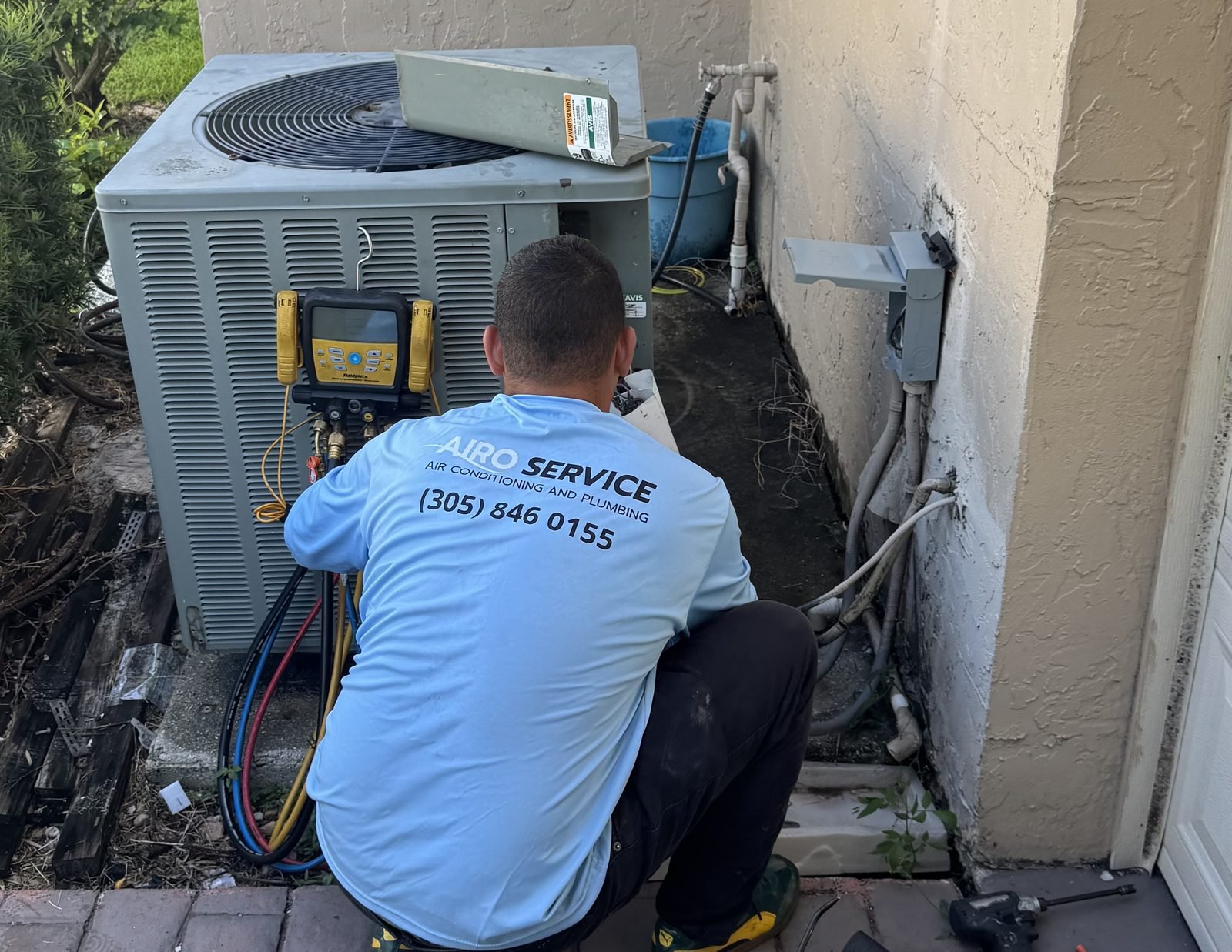
This is one of the more methodical diagnoses on a residential system, and it is largely measurement rather than guesswork: measured amp draw on the compressor and both motors against nameplate values, capacitor capacitance against its rated microfarads, insulation resistance from the compressor windings to ground — the test that identifies a shorted compressor definitively — contactor and terminal condition, voltage at the disconnect under load, and refrigerant pressures once the electrical side is clear.
The reason that sequence matters is that several very different faults produce the identical symptom, and only one of them justifies replacing the system.
Two things worth knowing
Do not fit a larger breaker. It comes up, and it is genuinely dangerous. The breaker is sized to protect the wire and the equipment, not to be adjusted until the nuisance stops. A larger one does not fix the fault; it removes the protection from it.
A tripping breaker is not the same as a blown fuse or a tripped float switch. If the system is simply dead with no breaker activity, that is a different set of causes — usually a condensate float switch, a control fuse or a thermostat problem.
How much of this is preventable
A fair share. Capacitors can be measured before they fail, contactors can be inspected before they weld, and the condenser coil that quietly raises current draw every summer can simply be cleaned. Those three checks are ordinary maintenance items, and they cover the majority of the cheap causes on the list above — which leaves the expensive one, a failing compressor, as something you find out about with warning rather than on the hottest afternoon of the year.
Frequently Asked Questions
How many times can I reset a tripping AC breaker?
Once. If it trips a second time, leave it off and call. The breaker has measured a real fault — excessive current or a short to ground — and repeatedly forcing it closed risks damaging the wiring and equipment, or worse.
Why does my AC trip the breaker only on hot days?
Because the system is marginal all the time and only crosses the current limit when conditions are worst. Common reasons are a condenser coil that cannot reject heat, low refrigerant making the compressor run hot, or a compressor that is beginning to fail.
Can a dirty outdoor coil trip a breaker?
Yes. A coil packed with grass clippings, lint or salt residue raises head pressure, which raises the compressor's current draw. On a system already close to its limit that is enough to trip the breaker, and it is one of the more common and most preventable causes.
Can I fit a bigger breaker to stop it tripping?
No, and it is dangerous. The breaker is sized to protect the wiring and the equipment rather than to be adjusted until the nuisance stops. A larger breaker does not fix the fault, it removes the protection from it.
How do I know if my compressor is shorted?
It is confirmed by measuring insulation resistance from the compressor windings to ground, which a technician does with a meter. The symptom that points there is a breaker that trips instantly on reset, before the system has a chance to start.
Breaker Tripping? Get It Diagnosed
We measure amp draw and insulation resistance rather than guessing at parts. Same-day appointments across South Florida.
- ✔ Free, No-Obligation Estimate
- ✔ Upfront Written Pricing — No Surprises
- ✔ 10-Yr Parts / 1-Yr Labor Warranty
- ✔ Serving Miami-Dade, Broward & Palm Beach
Prefer to talk? Call (305) 846-0155.
