
Mitsubishi Ductless Maintenance Checklist for Salt Air and Homes Near the Water
Salt, sun and humidity work on a ductless system from the outside in. Here is what owners near the ocean, the bay or the Intracoastal can do themselves, and what a coastal maintenance visit should cover.
By Roman Shatokhin · Airo Service · November 2026
How do I maintain a Mitsubishi ductless system near the water?
Keep the indoor filters clean every month, keep the outdoor unit clear and visible, check it after storms and windy weeks, and have a technician service it more often than an inland system — commonly twice a year — with a coil cleaning, corrosion check, electrical inspection and drain service.
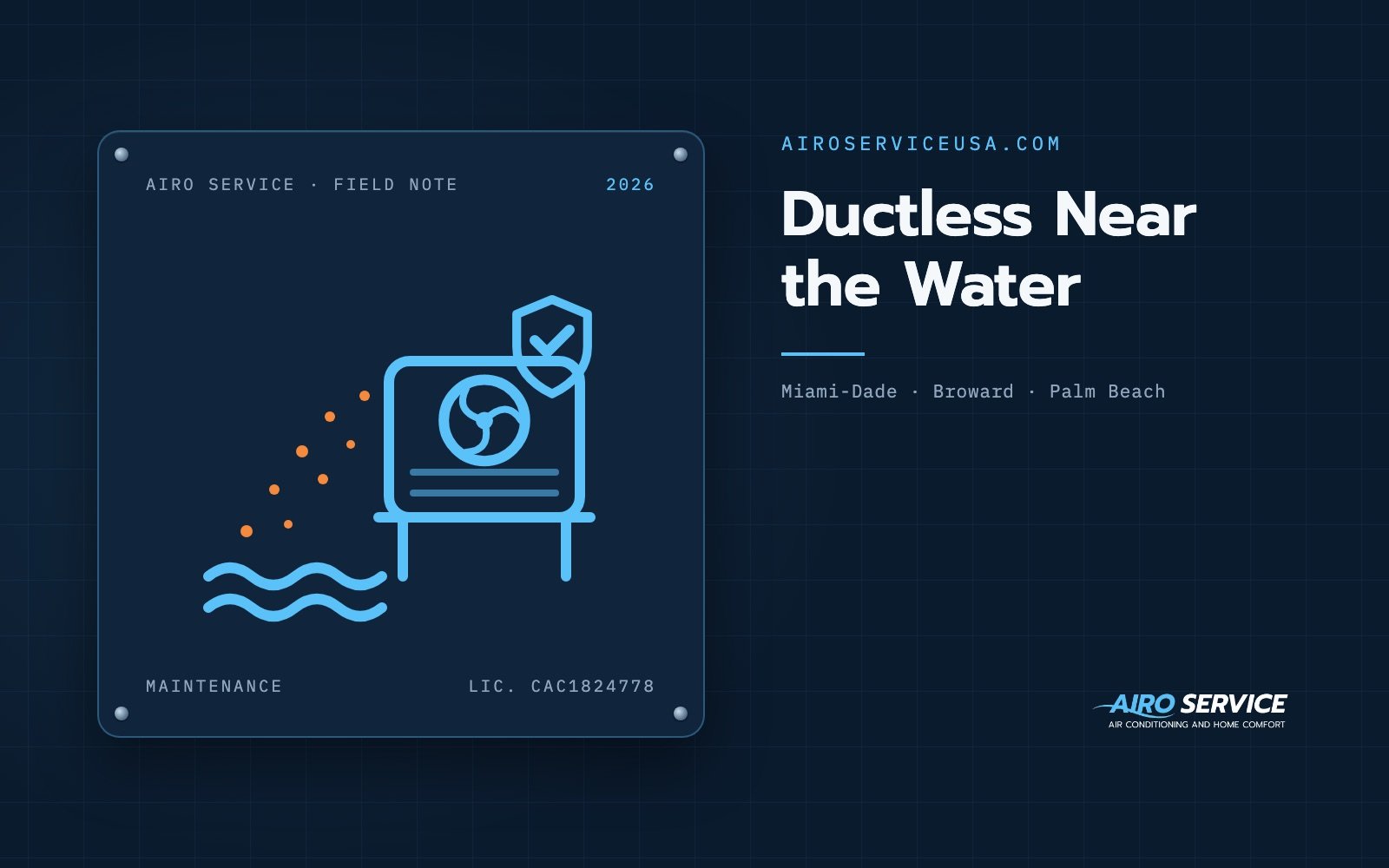
Salt air does not break a mini-split overnight. It works slowly, mostly on the outdoor unit: the thin aluminum coil fins, the fasteners and panels, and the electrical connections. Homes in Miami Beach, Key Biscayne, Sunny Isles, Hollywood, Fort Lauderdale beach, Boca Raton and anywhere along the Intracoastal see it sooner. The checklist below is built around that.
What can I do myself every month?
- Clean the indoor filters. Open the front panel, slide the mesh filters out, rinse with lukewarm water, dry in the shade and reinstall. Step by step in our guide to cleaning a Mitsubishi filter.
- Look at the outdoor unit. White or green crust on the coil, rust on screws and panels, or flaking paint are signs to mention at the next service visit.
- Keep it clear. Leave open space around the outdoor unit, free of plants, stored furniture, pool equipment and covers. Clear leaves and debris by hand with the unit off.
- Check the drain outlet. Make sure the outside end of the condensate drain is not buried, crushed or blocked.
- Watch the remote. If the operation light blinks or a code appears, write it down. Our Mitsubishi error code guide explains what common codes usually mean.
What should I check after a storm or a windy week?
- Debris packed against the coil or inside the fan guard. Clear only what you can reach by hand from the outside, with the unit off.
- The unit still sitting level and secure on its stand, pad or wall bracket, with anchoring straps in place. In Miami-Dade and Broward, outdoor units fall under High-Velocity Hurricane Zone anchoring requirements.
- Line set insulation torn or missing, which lets the lines sweat and degrades faster in sun and salt.
- Water standing around the unit or the disconnect box.
If the unit was submerged, if the disconnect box or wiring got wet, or if anything looks damaged, leave it off and have it checked before you turn it on. That is a safety matter, not a maintenance one.
What should a coastal maintenance visit include?
A standard maintenance visit covers the basics. Near the water, ask that it also includes:
- Outdoor coil cleaning with a coil-safe cleaner and a thorough fresh-water rinse to remove salt deposits.
- Corrosion inspection of the coil, fins, cabinet, fasteners, stand or bracket and line set fittings, with photos so you can see changes over time.
- Electrical connections checked and tightened where needed at the outdoor unit and disconnect — salt and humidity loosen and corrode them.
- Indoor unit inspection of the coil and blower wheel, plus drain pan and drain line cleaning. Algae grows fast in our heat, and a clogged drain is the most common cause of a Mitsubishi mini-split leaking water.
- Operating checks of temperatures, pressures and amperage against the manufacturer’s data, to spot a slow refrigerant leak early.
- Line set insulation and wall penetrations checked and sealed.
- A written report listing anything that should be addressed before it becomes a failure.
Our AC maintenance service covers ductless systems, and our Mitsubishi mini-split repair team handles whatever the inspection finds.
How often should a coastal system be serviced?
Inland, many systems are fine with one professional visit a year. Close to the water, twice a year is common, because salt deposits build up between visits and our systems run most of the year. A unit on an oceanfront balcony or a rooftop exposed to spray may need more attention than one tucked behind a building a few blocks inland. Your technician can recommend an interval based on what the coil looks like after the first year.
What should I not do?
- Do not use a pressure washer on the outdoor unit. It flattens fins and forces water into places it should not go.
- Do not spray household chemicals, vinegar or bleach onto coils. Some speed up corrosion.
- Do not open panels held by screws. Behind them are electrical parts.
- Do not wrap or cover the outdoor unit while it can run. It needs to move air.
- Do not paint over corrosion on the coil. It insulates the coil and traps salt underneath.
What about condo balconies and rooftops?
Many coastal condos have the outdoor unit on a balcony, a rooftop or a shared mechanical area. Those spots are often the most exposed to spray and wind, and the hardest to reach for cleaning.
- Balcony units should keep their clearances. Storage, planters and hurricane shutters stacked against the unit trap salt and heat.
- Rooftop and shared areas usually need building access, so coordinate service visits with management and keep the access rules on file.
- Who maintains what depends on your declaration of condominium and bylaws — check yours before scheduling work on equipment outside your unit.
Buildings with a central Mitsubishi system rather than individual units can read our guide to CITY MULTI VRF for condo boards.
What if I am choosing new equipment near the water?
Placement and protection matter as much as the brand. Mitsubishi Electric offers seacoast-protected options for some outdoor units; availability depends on the model, so ask about it when you choose equipment. Mounting the outdoor unit where it is sheltered from direct spray, anchoring it to code and planning access for cleaning all add years of service. Our ductless mini-split page explains single-zone and multi-zone options, and larger homes and buildings can see the Mitsubishi VRF overview.
Who services Mitsubishi systems near the water?
Airo Service is an authorized Mitsubishi Electric dealer and is certified by Mitsubishi Electric on CITY MULTI VRF, licensed in Florida (CAC1824778) and insured. We service ductless systems in homes and condos from Miami Beach to West Palm Beach, often the same day you call. The diagnostic is $0 when you go ahead with the repair, and every repair starts with a written price.
Frequently Asked Questions
How does salt air damage a mini-split?
Salt carried in sea spray and humid air settles on the outdoor unit. Combined with moisture it corrodes the thin coil fins, fasteners, cabinet panels and electrical connections. Over time the coil transfers heat less well, connections loosen and parts fail sooner than they would inland.
How often should a mini-split near the ocean be serviced?
Homes and condos close to the ocean, bay or Intracoastal benefit from professional maintenance more often than inland homes, commonly twice a year, plus your own monthly filter routine. The right interval depends on how close the unit is to the water, how exposed it is to wind-driven spray and how many hours it runs.
Can I rinse my outdoor mini-split unit with a hose?
Ask a technician first. Gentle fresh-water rinsing is part of many coastal maintenance routines, but the power must be off, the pressure must be low and water should not be forced into electrical compartments. Never use a pressure washer, which bends fins and drives water where it does not belong.
Are there Mitsubishi units built for coastal areas?
Mitsubishi Electric offers seacoast-protected options for some outdoor units. Availability depends on the model, so ask about it when choosing equipment for a home or building near the water. Placement, anchoring and regular maintenance still matter as much as the equipment itself.
Living Near the Water?
The diagnostic is $0 when you go ahead with the repair. Same-day service across Miami-Dade, Broward and Palm Beach.
- ✔ Free, No-Obligation Estimate
- ✔ Upfront Written Pricing — No Surprises
- ✔ 10-Yr Parts / 1-Yr Labor Warranty
- ✔ Serving Miami-Dade, Broward & Palm Beach
Prefer to talk? Call (305) 846-0155.