
Mitsubishi Mini-Split Blinking Light: What It Means and What to Do
A blinking operation light is the unit telling you it stopped to protect itself. Here is how to read it, what you can safely check, and when one restart is enough.
By Roman Shatokhin · Airo Service · November 2026
Why is my Mitsubishi mini-split light blinking?
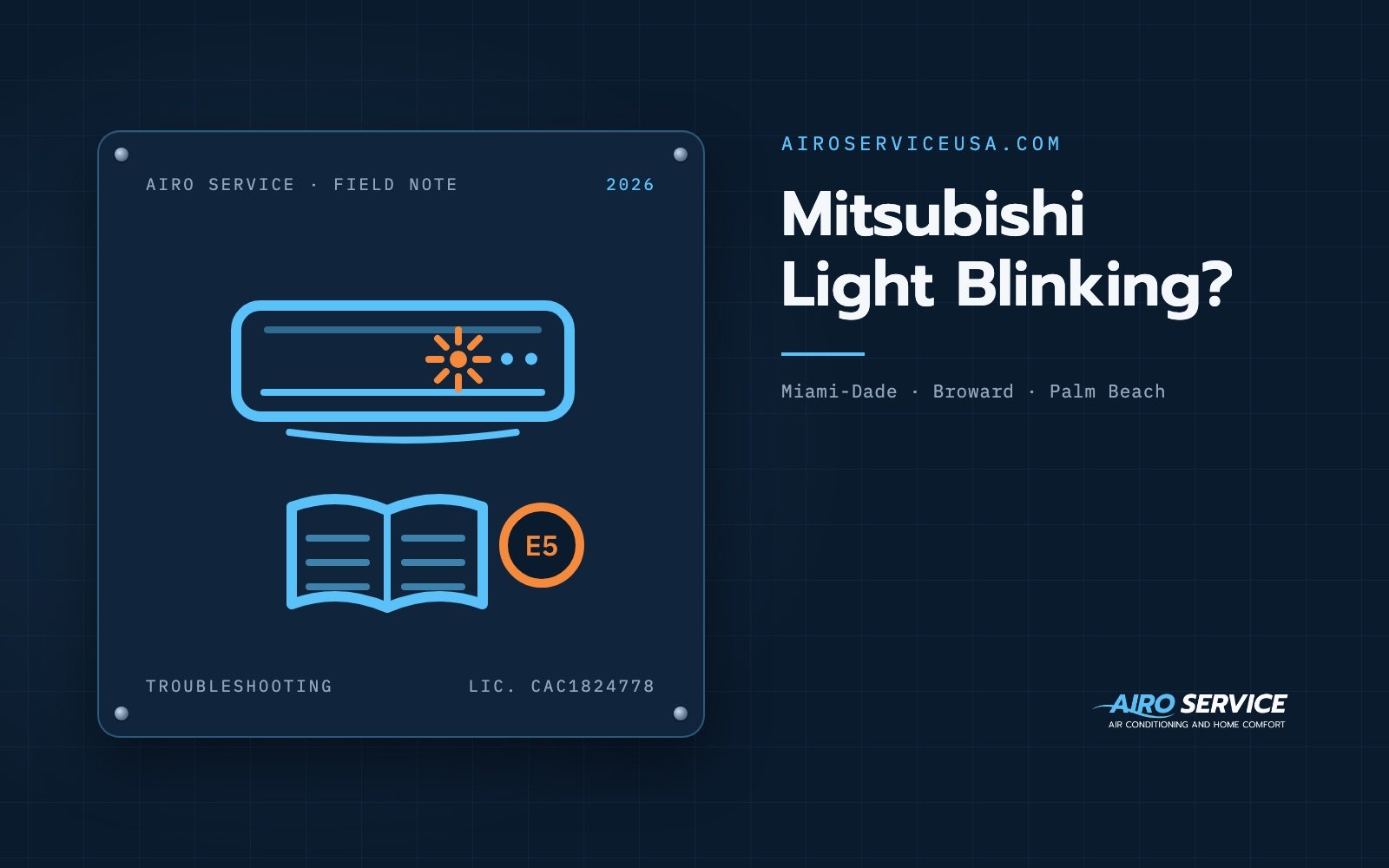
A blinking operation light on a Mitsubishi Electric mini-split usually means the system detected a fault and shut down to protect itself. On many models you can read a code from the remote or wired controller that points to the area — communication, drain, sensor or refrigerant side. The exact meaning depends on the model.
That last sentence matters. Mitsubishi has made many indoor and outdoor model series over the years, and blink patterns and codes are not identical across all of them. A chart you find online may describe a different generation. Use the information below as a guide to what is usually going on, then confirm with the manual for your model or the label inside the unit’s cover.
Is a blinking light always a fault?
Not always. Before assuming the worst, rule out the normal reasons a light can flash or change:
- Start-up and mode changes. Some models flash briefly while starting or changing modes.
- Heat-mode defrost. In heat mode on a cold morning, the unit may pause the indoor fan while the outdoor unit defrosts, and the light may indicate this. In South Florida it is rare, but the first cold fronts do bring it.
- Timer or special functions. A timer, economy or filter reminder can use the same lights on some models.
The fault pattern is different: the unit stops cooling, the fan stops or the outdoor unit goes quiet, and the light keeps blinking in a repeating pattern.
What should I do first when it starts blinking?
- Write it down. Note the blink pattern (how many flashes, which light) or the code shown on the remote or controller, the model number from the label, and what the unit was doing when it stopped. This alone can save time on the service call.
- Check the filters. Clogged filters starve the coil of air and can trigger coil-temperature protection. See our step-by-step guide to cleaning a Mitsubishi filter.
- Look at the outdoor unit. Make sure it is not covered, boxed in by plants, or packed with leaves and lawn clippings. Clear anything around it by hand. Do not open its panels.
- Check the breaker. The outdoor unit usually has its own breaker in the panel and a disconnect box next to it. If the breaker has tripped, reset it once. If it trips again, leave it off and call.
- Look for water. Water dripping from the indoor unit or a full condensate pump points toward a drain problem.
- Restart once. Turn the unit off, switch off the breaker or disconnect, wait about five minutes, restore power and turn it on.
If the light comes back, stop there. Resetting a fault over and over does not fix it, and some faults get worse with every restart.
What do the common Mitsubishi codes usually mean?
These are the codes we explain most often. On many models they usually mean the following — but meanings vary by model and generation, so always confirm with your manual.
- E6 — the indoor and outdoor units are not communicating. Often a tripped breaker outdoors, a loose or corroded connection, or a board problem.
- P5 — on many indoor units, a drain problem: the float switch has tripped, the drain is clogged or the drain pump has failed.
- P8 — abnormal coil temperature. Often linked to airflow (dirty filter or coil), refrigerant charge or a valve.
- U2 — high compressor discharge temperature, often caused by low refrigerant from a leak.
- P1 / P2 — a temperature sensor problem on the indoor unit (room air or coil sensor, depending on the model).
Larger Mitsubishi systems use four-digit codes. On CITY MULTI VRF, 2502 usually points to an indoor unit drain pump fault and 6607 to no acknowledgement on the M-NET communication line. Our full Mitsubishi error code guide covers these in more detail.
Remember that a code names the protection that tripped, not necessarily the part that failed. A P8 can be caused by a dirty coil. A U2 is often a leak rather than a bad compressor. That is why a code is where a diagnosis starts, not where it ends.
Which faults are most common in South Florida?
Our climate shapes what goes wrong. Three patterns stand out:
- Drain faults. High humidity means a mini-split removes a lot of water, and algae grows quickly in warm drain lines. A slow drain becomes a full pan, the float trips, and the unit stops with a drain code. More on that in Mitsubishi mini-split leaking water.
- Communication faults after storms. Power flickers, surges and water in outdoor connections can interrupt indoor-to-outdoor communication.
- Corrosion near the water. Salt air attacks outdoor coils and electrical connections over time. Homes on the barrier islands and along the Intracoastal see it sooner. Our salt-air maintenance checklist covers what helps.
When should I stop and call a technician?
Call once you have done the safe checks above and any of these is true:
- The light starts blinking again after one restart.
- The breaker trips again after you reset it.
- Water is dripping from the indoor unit or the drain pump runs constantly.
- You see ice on the copper lines or hear hissing near the connections.
- The code points to communication, sensors, boards or refrigerant.
Everything past the filters, the remote, the breaker and clearing around the outdoor unit involves electrical parts or refrigerant. That belongs to a licensed technician with the right tools and the service information for your model.
How Airo Service handles a blinking Mitsubishi
Airo Service is an authorized Mitsubishi Electric dealer and is certified by Mitsubishi Electric on CITY MULTI VRF. When we arrive, we read the code and the unit’s history where the model allows it, then test the part the code points to before replacing anything. You get a written price before any repair starts, and the diagnostic is $0 when you go ahead with the repair.
We offer Mitsubishi mini-split repair across Miami-Dade, Broward and Palm Beach, often the same day you call. If the unit has blinked more than once this year, it is also worth adding it to a maintenance schedule so the drain and coils are cleaned before the next fault.
Frequently Asked Questions
Why is the light on my Mitsubishi mini-split blinking?
A blinking operation light usually means the unit detected a fault and stopped to protect itself. On many models the remote or wired controller can show a code that narrows down the cause, such as a communication, drain or sensor problem. The meaning varies by model, so check your manual and write the code down for the technician.
How do I reset a blinking Mitsubishi mini-split?
Turn the unit off with the remote, switch off its breaker or disconnect, wait about five minutes, then restore power and turn it on. Do this once. If the light starts blinking again, stop resetting it, because repeated restarts can hide the cause or stress a part that is already failing.
What does E6 mean on a Mitsubishi mini-split?
On many Mitsubishi models E6 usually means the indoor and outdoor units are not communicating. Common causes include a tripped breaker for the outdoor unit, a loose or damaged connection, or a board problem. Meanings vary by model, so confirm in your manual. Checking the breaker is safe; wiring and boards are a technician job.
Is it safe to keep using a mini-split with a blinking light?
If the unit has stopped and the light is blinking, leave it off after one restart attempt. If it is a drain fault, running it again can cause water damage; if it is a refrigerant or temperature fault, it can stress the compressor. Call for a diagnosis and give the technician the code and the model number.
Light Still Blinking?
The diagnostic is $0 when you go ahead with the repair. Same-day service across Miami-Dade, Broward and Palm Beach.
- ✔ Free, No-Obligation Estimate
- ✔ Upfront Written Pricing — No Surprises
- ✔ 10-Yr Parts / 1-Yr Labor Warranty
- ✔ Serving Miami-Dade, Broward & Palm Beach
Prefer to talk? Call (305) 846-0155.