

Is a Radiant Barrier Worth It in Florida?
It can be, in the right attic. Here is how a radiant barrier works, when it earns its keep in South Florida, when it does not, and what to fix before you spend a dollar on one.
By Roman Shatokhin · Airo Service · November 2026
Is a radiant barrier worth it in Florida? Often — but not first
A radiant barrier can be worth it in South Florida because our roofs take strong sun most of the year and many homes have ducts and the air handler in the attic. It cuts the heat the roof deck radiates down. It pays off best after insulation and duct leaks are handled, and it does not replace either.
That last sentence is the part most sales pitches leave out. A radiant barrier is a good third step and a poor first step.
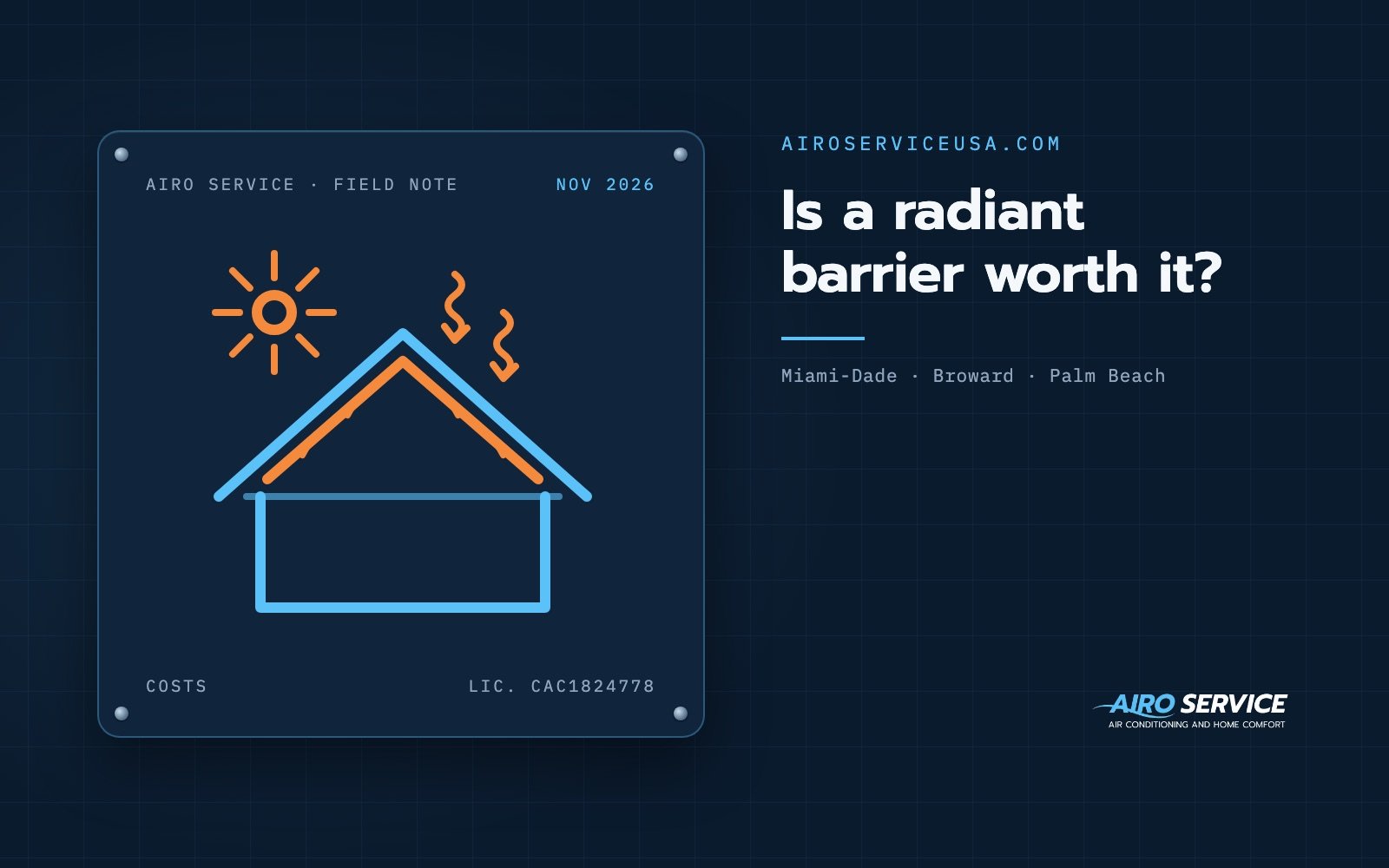
What a radiant barrier actually does
On a sunny afternoon the roof deck gets hot, and the underside of that deck radiates heat downward onto everything in the attic: the insulation, the ductwork, the air handler, the top of your ceiling. That radiant heat is a large share of what makes a Florida attic so brutal.
A radiant barrier is a highly reflective, low-emissivity surface — almost always aluminum foil on a backing — installed so it faces an open air space. A hot deck with foil under it gives off far less radiant heat into the attic below.
Two things it does not do:
- It does not insulate in the usual sense. Insulation slows heat moving by conduction. A radiant barrier deals with radiation. You need both, and they solve different problems.
- It does not work without an air gap. Foil pressed tight against another material, with no air space on its reflective side, stops acting as a radiant barrier.
Why South Florida homes are good candidates
- Sun and season. Our cooling season is most of the year, so any reduction in attic heat has many months to work.
- Ducts in the attic. In many single-family homes here, the supply ducts run through the attic. Cool air travelling through a hotter attic picks up heat before it ever reaches a room. Cooler attic, cooler duct surfaces.
- Air handlers in the attic. Plenty of homes have the air handler up there too. Our post on air handlers in South Florida attics explains why that location is hard on equipment.
- Hot second floors. Upstairs rooms sit directly under the attic. If yours are always the warmest rooms in the house, attic heat is often part of the reason — see why upstairs is hotter than downstairs.
When it is not worth it — yet, or at all
- Your insulation is thin or packed down. If the attic floor insulation is well below where it should be, topping it up comes first. Our blown-in attic insulation page explains what that involves.
- Your ducts leak. Cooled air escaping into the attic is money leaving through gaps, and no foil fixes that. The signs are in our guide to leaky ducts, and Aeroseal duct sealing is one way to close them from the inside.
- Your attic is already inside the envelope. Homes with spray foam on the underside of the roof deck have a sealed attic that stays close to indoor temperature. A radiant barrier adds little there.
- There is no attic. Most condos, and homes with flat roofs and no accessible attic space, are not candidates.
- The roof barely sees the sun. Heavy shade, or a light, highly reflective roof surface, already reduces the heat a radiant barrier would block.
The ways it gets installed
- Foil attached under the rafters or trusses. The most common retrofit. The foil hangs below the roof deck with an air space on its reflective side. It is slow, hot work in a cramped attic, especially around tile-roof framing and roofing nails.
- Radiant barrier roof sheathing. Roof decking that comes with foil already bonded to the underside. It can only go in when the roof deck is replaced, which makes a re-roof the cheapest moment to add a radiant barrier. If you are planning a new roof, ask your roofer about it.
- Foil laid on top of the attic floor insulation. We generally steer people away from this. Dust settles on foil that faces up and steadily kills its reflectivity, and in a humid climate a solid sheet over insulation can trap moisture. It also makes future work in the attic harder.
- Reflective coatings sprayed on the roof deck. Easier to apply, but generally less effective than foil, and quality varies widely.
Whichever method is used, foil conducts electricity, so a good installer keeps it clear of wiring, junction boxes and recessed light housings, and does not block attic vents.
What affects how much it saves
You will see websites promising a fixed percentage off your cooling bill. Anyone who quotes you a number without looking at your attic is guessing. What actually decides the result:
- How much insulation you have now, and its condition.
- Whether the ducts and air handler are in the attic, and how leaky the ducts are.
- Roof material and color — dark shingle, tile or metal behave differently.
- Attic ventilation and how much shade the roof gets.
- How many hours your AC runs, and your thermostat settings.
- Your electricity rate. Under FPL’s 2026 rates, a typical residential bill is about $136.64 per 1,000 kWh.
The more of those that point toward a hot attic full of ducts, the stronger the case. If most of them point the other way, your money will likely do more somewhere else. Our guide on lowering your South Florida cooling bill ranks the usual options.
What it costs, and why we will not quote it blind
The price of a radiant barrier depends on the attic, not just the square footage of the house:
- Attic floor area and roof pitch.
- Access — how easy it is to move around up there, and how tight the truss spacing is.
- Roof type, since tile roofs often mean more nails and framing to work around.
- The method: retrofit foil, new sheathing during a re-roof, or a coating.
- Whether it is done together with insulation or duct work in the same visit.
Because those vary so much, the only reliable number is a written quote from someone who has seen your attic. We are happy to look at the attic and give you an honest view of whether insulation, duct sealing or a radiant barrier is the better first dollar for your home.
The order we suggest
- 1. Fix the ducts. Seal leaks and repair disconnected or crushed runs.
- 2. Bring insulation up to where it should be.
- 3. Then consider a radiant barrier, especially if the ducts or air handler live in the attic.
- 4. If a new roof is coming, ask about radiant barrier sheathing while the deck is open.
One practical note: late fall is the most comfortable time of year to work in a South Florida attic. If you want the attic looked at, now is better than July.
Frequently Asked Questions
Does a radiant barrier really work in Florida?
It can, because Florida roofs take strong sun for most of the year and many homes have ducts and air handlers in the attic. A radiant barrier reflects heat radiating from the hot roof deck. It works best in addition to good insulation and sealed ducts, not instead of them.
Is a radiant barrier better than more attic insulation?
They do different jobs. Insulation slows heat moving by conduction through the attic floor; a radiant barrier reduces radiant heat coming off the roof deck. If your insulation is thin or compressed, adding insulation usually comes first. A radiant barrier is a good next step once insulation and duct leaks are handled.
How much will a radiant barrier lower my electric bill?
Nobody can honestly promise a number without seeing your attic. The result depends on your current insulation, whether ducts and the air handler are in the attic, duct leakage, roof material and color, ventilation, shade, how much your AC runs and your electricity rate.
Can I lay radiant barrier foil on top of my attic insulation?
It is generally not recommended. Dust collects on upward-facing foil and reduces its reflectivity over time, and in a humid climate a solid sheet over insulation can trap moisture. Foil installed under the rafters, or radiant barrier sheathing added during a re-roof, avoids those problems.
How much does a radiant barrier cost in South Florida?
It depends on the attic: floor area, roof pitch, access, truss spacing, roof type and the installation method. Adding it during a re-roof is usually the least expensive route. The only reliable number is a written quote after someone has inspected the attic.
Not Sure What Your Attic Needs First?
We look at insulation, ducts and the attic together and put any price in writing. Same-day service across Miami-Dade, Broward and Palm Beach.
- ✔ Free, No-Obligation Estimate
- ✔ Upfront Written Pricing — No Surprises
- ✔ 10-Yr Parts / 1-Yr Labor Warranty
- ✔ Serving Miami-Dade, Broward & Palm Beach
Prefer to talk? Call (305) 846-0155.