

Where Can the Outdoor Unit Actually Go?
Setbacks, clearances, hurricane tie-downs and association rules all constrain the answer — and getting it wrong costs capacity, lifespan or an inspection.
By Roman Shatokhin · Airo Service · Updated October 2026
Clearance comes first, because physics does not negotiate
A condenser rejects heat by pulling air across a coil and throwing it out the top. Starve that airflow and head pressure rises, capacity falls, current draw rises and the compressor wears faster. Every one of those costs you money continuously.
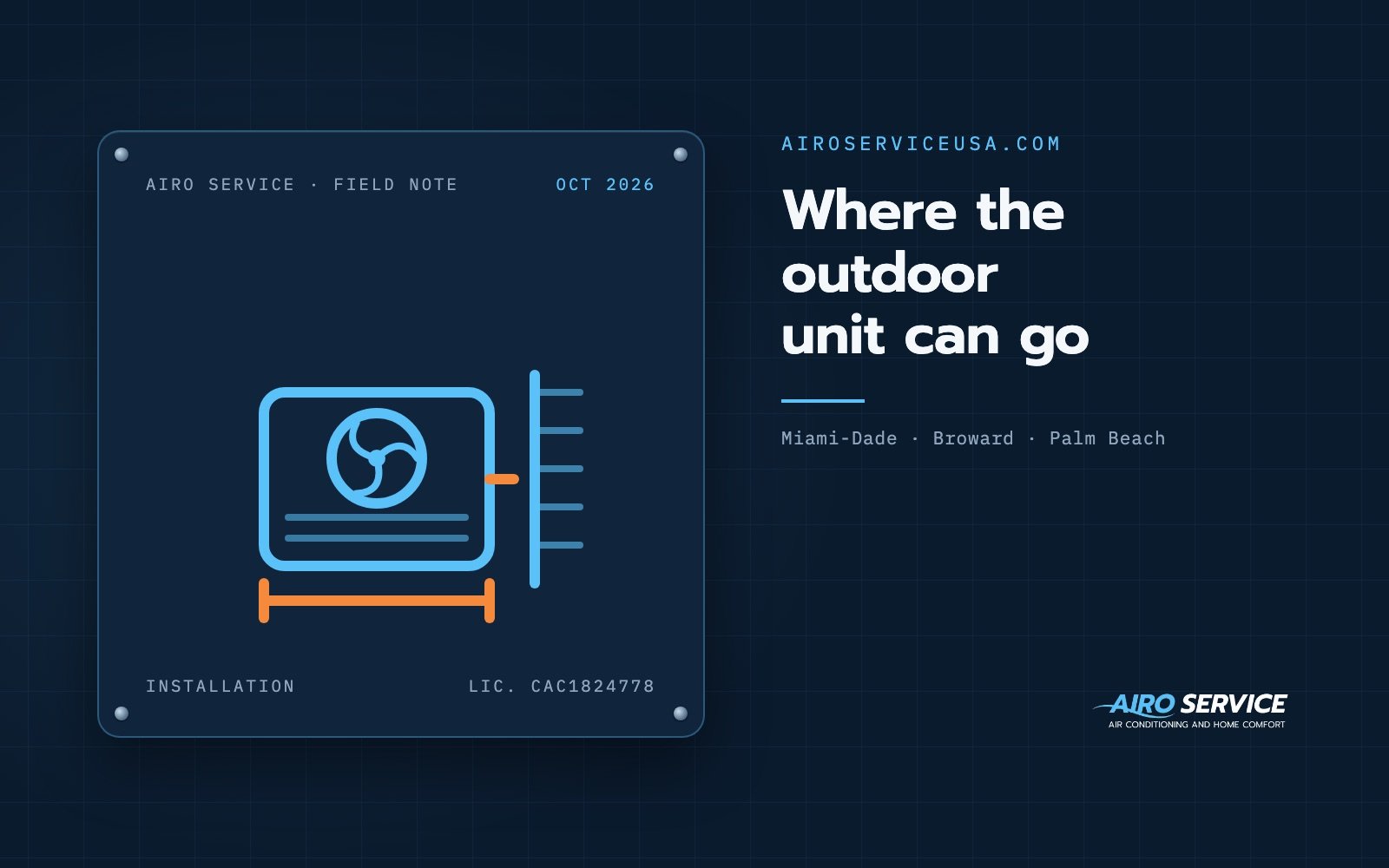
Manufacturers specify minimums — commonly around 12 to 24 inches on the sides and several feet of unobstructed space above. Check the specific unit rather than assuming, and treat those numbers as minimums, not targets. The most common real-world violations are hedges grown in, fence panels added later, and storage stacked beside the unit.
Setbacks and code
Municipalities set how close mechanical equipment may sit to a property line, and requirements differ across Miami-Dade, Broward and Palm Beach and between cities within them. There are usually also rules about blocking egress, walkways and utility access.
Your building department is the authority. A contractor pulling the permit should know the local requirement — and the fact that a permit is being pulled is itself a good sign.
Hurricane anchoring is not optional
In this region the outdoor unit must be secured against wind. That means an approved pad or stand and proper tie-downs or straps rated for the job. This gets inspected, and it matters beyond compliance: an unanchored condenser is a projectile and an insurance conversation.
If you are replacing a unit that was never properly anchored, this is the moment to correct it rather than reuse a cracked, unlevel pad.
Elevation, because water is a Florida problem
Ground-mounted equipment in a flood-prone area belongs on a raised stand. A condenser that sits in standing water suffers electrical damage and corrosion, and units that have been submerged should be inspected before being run at all. In some areas elevation requirements are formalised; in many others it is simply good sense.
Salt exposure changes the calculus
Within roughly three miles of the coast, salt attacks coils, fan motors and electrical contacts. Placement can help — a position sheltered from direct onshore wind and spray ages better than one fully exposed. Where exposure is unavoidable, coil coatings and corrosion-resistant hardware are worth the premium; the difference in service life is measured in years, not months.
The rules people forget
- Association approval. Most condo and HOA communities require architectural approval for anything visible, and many have specific rules about balcony and rooftop placement.
- Noise. A unit close to a neighbour's bedroom wall creates a complaint even when it is mechanically perfect. Worth considering before the concrete goes down.
- Service access. A technician needs room to open panels and work. Equipment wedged into a corner gets serviced badly, which is how it fails early.
- Line set length and lift. Moving a unit further from the air handler is not free — there are limits, and exceeding them costs capacity.
Before you move anything
Get the manufacturer's clearance spec, the municipal setback, and the association requirement in writing. Those three determine what is actually possible, and finding out afterwards is expensive.
Frequently Asked Questions
How much clearance does an AC condenser need?
Manufacturers commonly specify around 12 to 24 inches at the sides and several feet of unobstructed space above, but check your specific unit. Treat those as minimums. Hedges, fence panels and stored items are the usual real-world violations.
Does an outdoor AC unit need hurricane straps in Florida?
Yes. Outdoor equipment must be secured against wind on an approved pad or stand with proper tie-downs, and this is inspected. Beyond compliance, an unanchored condenser is a projectile and a potential insurance problem.
Can I put my condenser anywhere on my property?
No. Municipal setback rules govern how close mechanical equipment can sit to a property line, and they vary by city and county. There are usually also rules about blocking egress and walkways. Your building department is the authority.
Should the unit be raised off the ground?
In flood-prone areas, yes — a raised stand keeps electrical components out of standing water and reduces corrosion. A unit that has been submerged should be inspected before it is run at all.
Do I need HOA approval to move my outdoor unit?
Usually, if it is visible. Most South Florida associations require architectural approval for exterior changes, and many have specific rules about balcony and rooftop placement. Get the requirement in writing before committing to a location.
Planning a Replacement or a Move?
We check clearances, code and association rules before we quote.
- ✔ Free, No-Obligation Estimate
- ✔ Upfront Written Pricing — No Surprises
- ✔ 10-Yr Parts / 1-Yr Labor Warranty
- ✔ Serving Miami-Dade, Broward & Palm Beach
Prefer to talk? Call (305) 846-0155.
