

Your AC Quit at Night: What to Safely Check Before the Tech Arrives
Five checks that take ten minutes, are safe to do yourself, and solve a real share of after-hours calls — plus the ones to leave alone.
By Roman Shatokhin, Owner & HVAC Specialist · Florida HVAC license #CAC1824778 · Updated August 2026
Start here, in this order
A meaningful share of after-hours calls come down to something on this list. Ten minutes now may save you a wait — and if it does not, you will have useful information for whoever arrives.
1. The thermostat
Confirm it is set to COOL, the setpoint is below the room temperature, and the fan is on AUTO. Check the screen is lit; if it is blank or showing a low-battery warning, fit fresh batteries. It sounds trivial, and it is regularly the answer — especially where a programmable schedule was overridden and forgotten, or someone bumped the mode.
2. The breakers
Most systems have two: one for the indoor air handler, one for the outdoor condenser. A tripped breaker does not always look obviously off — it can sit in a middle position. Switch it fully OFF, then back ON.
If it trips again immediately, stop. Leave it off and call. A breaker tripping repeatedly is protecting you from a real electrical fault, and resetting it over and over is genuinely dangerous.
3. The float switch and drain pan
This is the one most homeowners have never heard of and it is a leading cause of “it just stopped.” If the condensate drain is blocked, water rises in the pan and a float switch cuts the system off to prevent water damage.
Look at the air handler — in the garage, a closet or the attic. Standing water in the pan, or a small switch on the drain line, points straight at this. Clearing it safely means shutting the system off and using a wet vac on the outdoor drain stub. Do not poke wire down the pipe.
4. The air filter
Pull it and look at it against a light. A badly loaded filter restricts airflow enough to freeze the evaporator coil, and a frozen coil stops cooling entirely. If you find ice on the indoor coil or on the copper line, switch the system to OFF and the fan to ON for two to three hours to thaw it, replace the filter, then restart. If it freezes again, there is a deeper airflow or refrigerant problem.
5. The outdoor unit
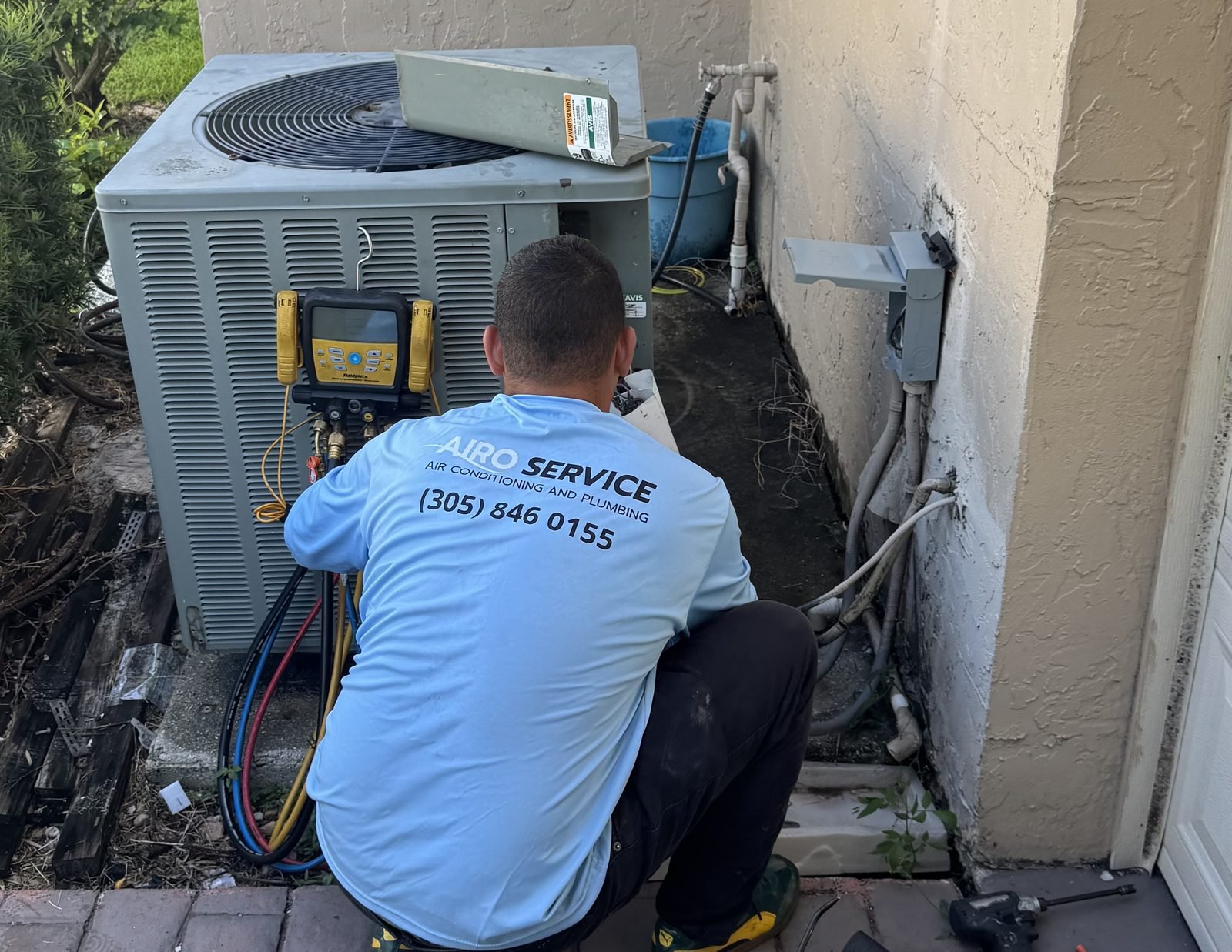
Is the fan on top spinning? Is the unit humming but not turning? Is it buried in hedge growth or covered by something?
Humming without spinning often points to a failed capacitor — a common, inexpensive part, but replacing it involves stored electrical energy that can injure you even with the power off. That is a technician job, not a video-tutorial job.
What to leave alone
- Anything involving refrigerant — it is regulated, and handling it without certification is illegal as well as unsafe
- Capacitors and contactors — stored charge, real injury risk
- Opening the electrical compartment of the condenser
- Repeatedly resetting a breaker that keeps tripping
- Adding “a can of refrigerant” — if it is low, it leaked, and topping it up without finding the leak wastes money and vents refrigerant
Keeping the house liveable while you wait
Close blinds on the sun side, run ceiling fans in occupied rooms, avoid the oven, and shut interior doors to concentrate cooling where people actually are. If anyone in the house is elderly, very young or medically vulnerable and indoor temperatures are climbing, treat it as urgent rather than waiting it out.
What to have ready when you call
The system age if you know it, what changed and when, whether the breaker tripped, whether there is ice or water anywhere, and what you have already tried. It genuinely shortens the diagnosis.
Frequently Asked Questions
My AC stopped working — what should I check first?
Thermostat mode and batteries, then both breakers, then the drain pan and float switch, then the filter, then whether the outdoor fan is spinning. Those five cover a real share of after-hours calls and take about ten minutes.
Why did my AC shut off by itself with no warning?
A common cause is the float switch cutting power because the condensate drain backed up — a safety feature, not a fault. Another is a tripped breaker. A third is a frozen evaporator coil from a badly loaded filter.
Is it safe to reset the AC breaker?
Once, yes — switch it fully off then back on. If it trips again immediately, leave it off and call. A breaker that keeps tripping is protecting you from a real electrical fault, and repeatedly resetting it is dangerous.
My outdoor unit hums but the fan does not spin. What is it?
Often a failed capacitor. It is a common and inexpensive part, but capacitors store electrical energy that can injure you even with the power off, so it is a job for a licensed technician rather than a DIY fix.
Can I add refrigerant myself?
No. Refrigerant handling is regulated and requires certification. More importantly, refrigerant is not consumed — if the system is low, it has leaked, and adding more without finding the leak wastes money and vents refrigerant to atmosphere.
Still Not Cooling?
Tell us what you have already checked — it gets us to the cause faster.
- ✔ Free, No-Obligation Estimate
- ✔ Upfront Written Pricing — No Surprises
- ✔ 10-Yr Parts / 1-Yr Labor Warranty
- ✔ Serving Miami-Dade, Broward & Palm Beach
Prefer to talk? Call (305) 846-0155.